
Projects
NAUTILOS
Robotics & AI
Autonomous swarm of underwater drones for hull cleaning and inspection
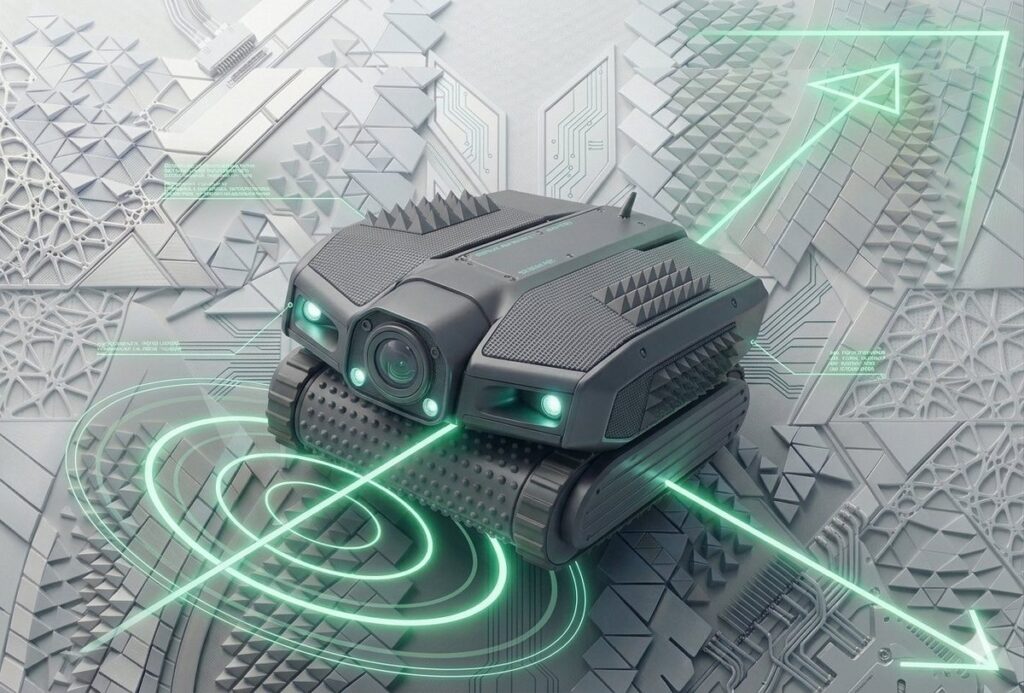
NAUTILOS develops the first industrially qualified autonomous swarm of underwater crawler drones for the systematic cleaning and inspection of ship hulls — without divers in the water and without taking the vessel out of service. Biofouling, the biological colonisation of submerged hull surfaces, increases hydrodynamic resistance by 10–40%, with proportional increases in fuel consumption and CO₂ emissions; current remediation requires dry-docking interventions costing over one million euros per event and up to fifteen days of operational downtime.
The project advances AMYRA’s drone — a patent-pending hull-crawler already validated at sea on vessels up to 20 meters — through three core innovations: GNSS/Galileo positional navigation with coverage mapping, AI-embedded image analysis for surface condition assessment, and cooperative multi-drone swarm coordination. Developed in consortium with Fast Computing and SISSA mathLab, NAUTILOS targets both civil maritime maintenance and dual-use defence applications.
AI Platform for Digital Inventory
Digital Inventory · Additive Manufacturing & AI
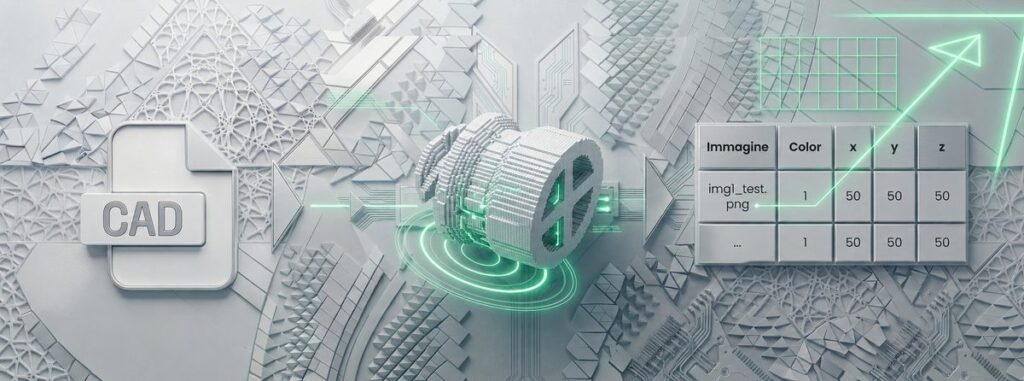
One of the most relevant opportunities in the industrial adoption of Additive Manufacturing is digital inventory: manufacturers hold thousands of part geometries — spare parts, tooling, structural components — but have no systematic way to identify which of them are suitable for additive production. However, the possibility to 3D print parts just in time and right at the moment and place they are needed, instead of physical inventories, is crucial to reduce working capital and save carbon footprint, lowering material use and transportation. Today this screening is done manually by expert operators, making scalable AM-based spare part manufacturing economically impractical.
The project addresses this directly by developing an AI algorithm — based on convolutional neural networks — that automates geometry scouting: given a CAD library as input, the system classifies each part by its suitability, generates Design for AM improvement suggestions, and reduces time-to-decision by up to 90%. This transforms a static part inventory into a dynamic, AM-ready digital catalogue. The project is developed and validated on industrial use cases in automation and fashion/luxury components produced from recycled metal powder.
Rare Earth Alternatives via Advanced Additive Processes
Rare Earth Substitution
The project investigates the characterisation and qualification of synthetic and metallic materials produced via laser-based deposition and sintering-based processes as alternatives or complements to rare earth materials in critical industrial applications. Coordinating with the start-up RARA Factory, the project validates a manufacturing approach and builds a structured dataset of material properties — magnetic, mechanical, and microstructural — to support the design of next-generation components in energy and defence supply chains with reduced rare earth dependency.
OLGA — Original Lace & Generative Artifacts
Digital Manufacturing
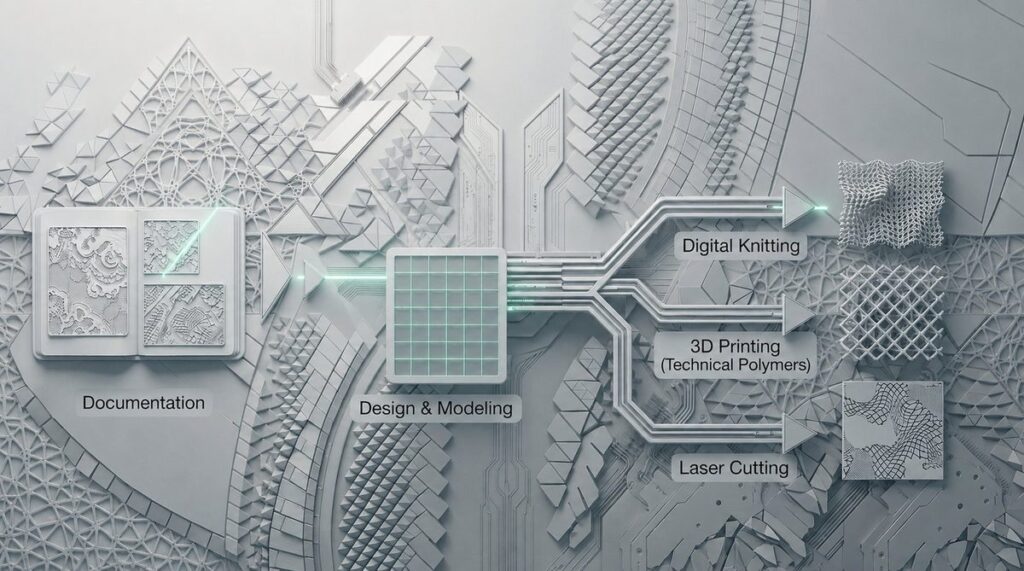
OLGA is an initiative dedicated to the valorisation of European historic textile heritage through digital technologies and innovative manufacturing processes. The project centres on the documentation, reinterpretation, and reproduction of antique lace — specifically the designs of the historical Venetian lace house Melville & Ziffer (est. 1898) — combining computational design, digital modelling, and emerging fabrication techniques including digital knitting, 3D printing with technical polymers, and laser cutting on technical fabrics. For AMYRA, OLGA represents a natural extension of our research into digital design and computational modelling applied to the fashion and textile sector: the challenge of translating historical artefacts into reproducible digital processes, while preserving their material and cultural integrity, offers particularly rich ground for exploring new approaches at the intersection of heritage and advanced manufacturing.